Tuesday, March 13, 2012

Lucas Oil to sponsor the Greek for remainder of his career


Lucas Oil founder Forrest Lucas has announced a unique sponsorship of Chris Karamesines that will last as long as the drag racing legend competes.

Lucas Oil first joined Karamesines, widely known as "the Greek," for seven national events in 2011 to rave reviews from the media and fans.

"The Greek is a legend in our sport," Lucas said. "He's a great ambassador for drag racing and our line of products, and we're happy to partner with him again. I look forward to seeing the Greek's dragster go down the track with our colors on his car for many years to come."

The Chicago native raced in 13 Top Fuel events last year, qualifying for four races. Karamesines earned a first-round victory at Bristol Dragway, his first round-win in NHRA competition in more than 20 years.

Karamesines, 82, has been racing since the 1950s and was recognized as one of NHRA's 50 Greatest Drivers in 2001. "The Greek" has won numerous national events in ADRA, AHRA and IHRA competition.

"I appreciate Forrest helping us out the way he does," Karamesines said. "We'll get to as many Top Fuel races as we can and will do our best for Lucas Oil. What they've done for our sport is tremendous and it's cool to have them on our car. We're very appreciative of their support."

Monday, February 20, 2012

Sunday At Firebird International Raceway Chandler,AZ

Sunday
at Firebird International Raceway
Chandler, Ariz.
Final finish order
TOP FUEL
1, Antron Brown; 2, Tony Schumacher; 3, Shawn Langdon; 4, Clay Millican; 5, Steve Torrence; 6, Doug Kalitta; 7, Spencer Massey; 8, Morgan Lucas; 9, Brandon Bernstein; 10, Khalid al Balooshi; 11, Bob Vandergriff; 12, Troy Buff; 13, Cory McClenathan; 14, Terry McMillen; 15, Mike Strasburg; 16, David Grubnic.
FUNNY CAR
1, Robert Hight; 2, Mike Neff; 3, Jack Beckman; 4, Courtney Force; 5, Jeff Arend; 6, Ron Capps; 7, Todd Lesenko; 8, Johnny Gray; 9, Bob Tasca III; 10, Tony Pedregon; 11, Cruz Pedregon; 12, Matt Hagan; 13, Grant Downing; 14, Jim Head; 15, Bob Bode; 16, John Force.
PRO STOCK
1, Jason Line; 2, Greg Anderson; 3, Greg Stanfield; 4, Rodger Brogdon; 5, Erica Enders; 6, Vincent Nobile; 7, Larry Morgan; 8, Mike Edwards; 9, Ronnie Humphrey; 10, Allen Johnson; 11. Kurt Johnson; 12, Warren Johnson; 13, Shane Gray; 14, Jeg Coughlin; 15, Ron Krisher; 16, Steve Kent.
Final Results
Top Fuel — Antron Brown, 3.793 seconds, 319.82 mph, def. Tony Schumacher, 3.813 seconds, 318.17 mph.
Funny Car — Robert Hight, Ford Mustang, 4.139, 307.02, def. Mike Neff, Mustang, 4.168, 309.91.
Pro Stock — Jason Line, Pontiac GXP, 6.558, 211.69, def. Greg Anderson, GXP, 6.570, 211.06.
Super Stock — Dan Fletcher, Chevy Camaro, 9.376, 144.04, def. Ken Etter, Plymouth Shadow, 10.166, 128.60.
Stock Eliminator — Leo Glassbrenner, Pontiac Firebird, 10.571, 116.81, def. Brad Hawk, Ford Mustang, 12.671, 103.00.
Super Comp — Greg Boutte, Dragster, 8.898, 174.71, def. Steve Whitfield, Dragster, foul.
Super Gas — Michael Miller, '27 Ford, 14.757, 84.36, def. Ed DeStaute, Chevy Corvette, broke.
Super Street — Ray Dew, Chevy Nova, 10.874, 128.63, def. Ryan Herem, Chevy Camaro, 10.867, 132.65.
Top Dragster — Tom Koenen, Dragster, 7.090, 189.39, def. JR Lobner, Dragster, 6.824, 196.99.
Top Sportsman — J Wayne Silvia, Chevy Cavalier, 11.560, 101.09, def. Ted Carli, Chevy Cobalt, broke.
Final round-by-round
TOP FUEL
ROUND ONE — Morgan Lucas, 3.832, 307.72, def. Khalid alBalooshi, 3.808, 318.17; Doug Kalitta, 3.828, 321.96, def. Bob Vandergriff, 3.874, 315.86; Antron Brown, 3.805, 321.96, def. Terry McMillen, 4.197, 219.19; Steve Torrence, 3.801, 322.04, def. Brandon Bernstein, 3.794, 319.75; Shawn Langdon, 3.770, 321.58, def. Troy Buff, 3.936, 302.82; Tony Schumacher, 3.770, 323.12, def. Mike Strasburg, 4.217, 208.91; Spencer Massey, 3.769, 325.37, def. Cory McClenathan, 3.964, 255.73; Clay Millican, 3.861, 314.31, def. David Grubnic, 4.817, 150.11.
QUARTERFINALS — Millican, 3.838, 317.87, def. Torrence, 3.796, 318.99; Langdon, 3.791, 318.39, def. Lucas, 4.508, 174.32; Schumacher, 3.819, 315.12, def. Kalitta, 3.856, 307.65; Brown, 3.888, 287.47, def. Massey, 3.987, 262.74.
SEMIFINALS — Schumacher, 3.797, 317.57, def. Millican, 8.924, 83.46; Brown, 3.832, 313.51, def. Langdon, 6.072, 106.18.
FINAL — Brown, 3.793, 319.82, def. Schumacher, 3.813, 318.17.
FUNNY CAR
ROUND ONE — Jeff Arend, Toyota Solara, 4.117, 308.64, def. Jim Head, Solara, 5.417, 139.86; Mike Neff, Ford Mustang, 4.072, 309.13, def. Bob Bode, Chevy Impala, 5.960, 143.75; Johnny Gray, Dodge Charger, 4.084, 310.34, def. Grant Downing, Charger, 4.422, 217.28; Todd Lesenko, Impala, 4.264, 266.79, def. Matt Hagan, Charger, 4.325, 293.92; Courtney Force, Mustang, 4.146, 307.30, def. John Force, Mustang, 7.364, 91.30; Jack Beckman, Charger, 4.090, 308.57, def. Tony Pedregon, Impala, 4.179, 304.53; Ron Capps, Charger, 4.162, 301.13, def. Cruz Pedregon, Solara, 4.210, 274.33; Robert Hight, Mustang, 4.095, 308.85, def. Bob Tasca III, Mustang, 4.157, 302.28.
QUARTERFINALS — Hight, 4.613, 241.97, def. Gray, DQ; Beckman, 4.172, 282.24, def. Arend, 4.322, 294.43; Neff, 4.264, 246.75, def. Capps, 7.000, 90.68; C. Force, 4.099, 306.95, def. Lesenko, 7.073, 93.02.
SEMIFINALS — Neff, 4.099, 306.74, def. Beckman, 4.129, 301.60; Hight, 4.158, 304.32, def. C. Force, 4.199, 299.93.
FINAL — Hight, 4.139, 307.02, def. Neff, 4.168, 309.91.
PRO STOCK
ROUND ONE — Rodger Brogdon, Pontiac GXP, 6.617, 209.98, def. Ron Krisher, GXP, 7.125, 140.23; Erica Enders, Chevy Cobalt, 6.581, 210.54, def. Steve Kent, GXP, 8.753, 108.86; Larry Morgan, Ford Mustang, 6.581, 209.72, def. Allen Johnson, Dodge Avenger, 6.598, 210.97; Vincent Nobile, Avenger, 6.571, 211.26, def. Shane Gray, GXP, 7.003, 158.82; Greg Stanfield, GXP, 6.623, 209.20, def. Ronnie Humphrey, GXP, 6.592, 210.93; Mike Edwards, GXP, 6.567, 210.73, def. Warren Johnson, GXP, 6.634, 208.39; Jason Line, GXP, 6.549, 211.56, def. Jeg Coughlin, Avenger, 7.078, 156.92; Greg Anderson, GXP, 6.555, 210.83, def. Kurt Johnson, GXP, 6.618, 209.52.
QUARTERFINALS — Stanfield, 6.636, 207.85, def. Morgan, 11.083, 77.23; Brogdon, 6.640, 208.68, def. Edwards, 14.908, 53.63; Anderson, 6.569, 211.39, def. Nobile, foul; Line, 6.561, 211.36, def. Enders, 6.610, 209.10.
SEMIFINALS — Anderson, 6.590, 210.21, def. Brogdon, 6.632, 208.36; Line, 6.556, 211.23, def. Stanfield, 6.618, 208.68.
FINAL — Line, 6.558, 211.69, def. Anderson, 6.570, 211.06.
Wednesday, February 15, 2012

Winternationals 2012


It took 5 days to complete, but the Winternationals at
the Auto Club Raceway in Pomona finally was completed 
a day late. Of course, the Pros finished the finals on Sunday, 
 for ESPN2, but Sportsman Finals were put off until the
following day. 
Fortunately for me and co-writer, Diana Luna, we were
able to have sit-down conversations with Antron Brown
and Matt Hagen the previous day.
That learned in the sit-down conversation was a bit more
about Matt Hagen, the # 12 qualifier and DSR driver of the 
Aaron/Mopar, and of course it carried the # 1 into the 
field this weekend. Being from Christansburg, VA, just having 
this informal conversation was a good learning process. 
The fact that he had a number of experiences in the roundy 
round circuit, he chose to dedicate his abilities in the field 
of driving a funny car for DSR. 
I gained a new respect for that which Matt brings to the sport, 
as well as he as an individual.  Of course, that respect did
not help much on the track in that the winner, John Force, 
was one who has been there so many times. I’ve had many
conversations with Force, in that my involvement began in the
sport began when he started using that phrase, “I’m just a truck driver”
has given many opportunities to sit with him. So much so, 
I was not surprised to see the John Force Grandstands 
in place.   
Antron Brown is a piece of work; excellent conversationalist, 
well read and a great communicator. When he qualified in 
the #2 spot, it was felt he could get around the field and back 
to the winners circle, but as Antron said, these races are won 
by a hundredth of a second, and so it was in nearly every round. 
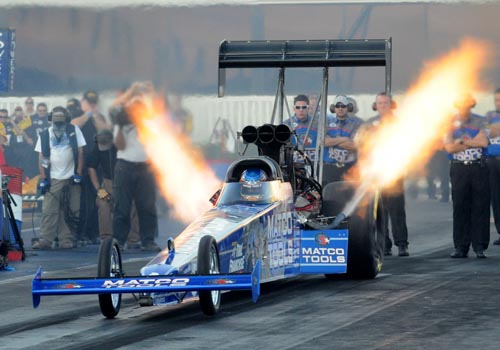
When experiencing Top Fuel, it’s like a volcanic eruption. 
He did make it to the finals;
 Rnd 1
W) Antron Brown (Matco Tools/Aaron's Dragster)   
                               0.054  3.801et  325.92 mph
(L) Cory McClenathan (Rapisarda Racing Dragster)
                             0.086  5.902 et  108.47 mph  
 Rnd 2
W) Antron Brown (Matco Tools/Aaron's Dragster)   
                          0.037   3.771et  323.35 mph
(L) Brandon Bernstein (MAV TV/Lucas Oil Dragster)
                      0.061   10.000 et  75.56 mph
 Rnd 3
(W) Antron Brown (Matco Tools/Aaron's Dragster)  
                     0.058-  3.819 et  320.28 mph
(L) Morgan Lucas (GEICO/Lucas Oil Dragster)  
                   0.0374.430 et  178.57 mph
 Rnd 4
(W) Spencer Massey (FRAM/Prestone Dragster) 
                   0.049  3.750 et  325.77 mph
(L) Antron Brown (Matco Tools/Aaron's Dragster) 
                 0.036  3.794 et  320.43 mph  
  Fuel Funny Car
Of course, these cars are so unpredictable;
the dominating car last year of Matt’s went 
out in first round of eliminations, losing to Ron Capps.
 
(W) Ron Capps (NAPA Auto Parts Charger)  
                    0.059      4.093 et  312.06 mph
(L) Matt Hagan (Aaron's/Mopar Charger)  
                0.062    4.298 et   269.73 mph
 There was a lot of action between first round and finals. 
However, between the rain and cold, we were only able 
to see/experience a small portion of eliminations. 
 This is final round results.
(W) John Force (Castrol GTX High Mileage Mustang 
                      0.067      4.080 et 315.64 mph
(L) Mike Neff (Castrol GTX Mustang) 
                    0.175      4.036 et 316.82 mph
 As you can see, the Force won this at the tree!

Wonder how that happened over his teammate?
 The weather was so cold, the air temp 63 degrees and
the track temp 69 degrees. My body temp seemed to be
at 20 and my mind told me to go inside the motor home
for a while. 
 Pro Stock
At the start of this process of eliminations, one wonders 
when the Pontiac emblem will finally be retired.  The 
only real way to tell the difference between the teams was 
the paint or in today’s world, wraps on the cars.  Engines 
are the same and except for a few red-lights, the win margins
were + or - .05 seconds at 210 mph or there about. 
Then came the final round  which Greg Anderson worked 
his way through the field for the  win over Jeg Coughlin; 
6.549 @ 210.87 to Jeg’s 6.586 @ 209.62. Very small margin 
for the win, but then that’s normal in this very competitive field.  
Maybe next year the variety will be better. 
 Most enjoyment was in the far off pit area for the 
Sportsman competitors which eliminations carried 
over until Monday, another cold day.
We will venture into the Sportsman Field and
Final results in the next post. 

Tuesday, February 7, 2012

Finally, a Ride for JR Todd & Larry Dixon

 Bob Vandergriff, Jr. has done anything but stand still this off season.
BobVandergriff, who won his first career NHRA Top Fuel national event last season, has been feverishly working to expand his Top Fuel team to a three-car operation with J.R. Todd and Larry Dixon as his other drivers.

"J.R. is a very good friend of mine and Larry Dixon and I have been very good friends, we kind of started our careers about the same time and we have known each other for a long time," Vandergriff said. "What we want to do is build a team that is capable of competing with the DSRs (Don Schumacher Racing) and the Alan Johnsons (Al-Anabi Racing) and to do that you have to have the right people in place as well as the funding."

Vandergriff felt especially fortunate that Todd and Dixon were looking for rides.
"For me, I think it is a blessing to have those two guys (Todd, Dixon) available out there to help market and to go to sponsors with," Vandergriff said. "With Larry Dixon, you have a three-time world champion and a guy who has won 60-something national events. That is a pretty impressive resume to present to potential companies that might want to get involved. For us, it just gives credibility to our program to have somebody like that involved with it. As far as J.R. Todd, he gives us another marketing angle. He gives us a younger demographic and he gives us a diversity angle that we can push to potential companies to get them involved in our sport. Best of all between those two guys, they are just both really good people. I think you have to have that to make it all work."

According to Vandergriff, Todd is for sure going to race at Houston (April 27-29), Atlanta (May 4-6) and Topeka, Kan. (May 18-20) for Vandergriff Motorsports. The NHRA season begins Thursday through Sunday at the Winternationals in Pomona, Calif. "We are working on expanding that into the 10 or 12 race scenario," Vandergriff said. 

"We have talked to a lot of companies and we are still knocking on doors. We are just waiting on some of these people to make commitments on behalf of that to make that happen. Things kind of got started late with Larry and that is the downside of where we are at right now because our season is getting ready to start and putting together something for 2012 is a longshot, but you never know. There may be something we can get started for some races, partial schedules, something to build towards may be getting somebody involved full time in 2013, and that is what we are using the season for, for him."

In Vandergriff's ideal world, he, Todd and Dixon would form a team at Vandergriff Motorsports and all three drivers would be competing in full seasons in 2013.

"That's obviously the goal, that is what we are trying to build towards," Vandergriff said. 

"That gives us the resources and the information and the people to compete against those other super teams. We saw the advantage last year of having a second car from an information standpoint. The amount of runs you get to make down a race track doubles, which is always nice, and it is just a huge help as far as learning and advancing your program." 

Monday, January 30, 2012

New Major Sponsor for NHRA Pro's


NHRA has signed a multiyear agreement with Traxxas, the leading manufacturer and seller of high performance radio-controlled vehicles. The agreement designates Traxxas as the Official Radio-Controlled Performance Products of the NHRA and will fully integrate the Traxxas brand into all aspects of NHRA, including extensive multimedia rights, broadcast elements, and a strong on-site presence, including interactive displays, signage, and entertainment features.

The sponsorship includes new Top Fuel and Funny Car specialty race-within-a-race programs, both sponsored by Traxxas. The specifics of the specialty programs, including locations for each event, will be announced at a later date. Traxxas will provide $260,000 to fund the two programs, and the Top Fuel and Funny Car specialty-race winners receiving $100,000 each.

“Traxxas comes to NHRA not only as marketing partners, but as longtime fans of the sport,” said Mike Jenkins, owner and president of Traxxas. “The extreme horsepower, speed, and excitement of NHRA Drag Racing is a great match for the performance we build into our radio-controlled products.”

Fans attending 2012 NHRA Full Throttle Drag Racing Series events will easily see the Traxxas presence throughout each racetrack. An interactive display within Nitro Alley will allow fans the opportunity to test drive one of the many premium radio-control vehicles the company has to offer. In addition, Traxxas will conduct trackside entertainment during the event to showcase the excitement, durability, speed, and maneuverability of its radio-control vehicles. Also, Traxxas signage will be seen on the on-site video screen.

“The program with Traxxas is one of the most comprehensive and extensive official sponsorships in NHRA Drag Racing,” said NHRA President Tom Compton. “As part of this sponsorship, we are very pleased to introduce two new specialty programs for Top Fuel and Funny Car. These two programs, which pair the best of the best in the two top classes, will be extremely popular with the fans and bring added excitement to the race weekend.”

As part of the agreement, Traxxas will have a major role during NHRA Full Throttle Drag Racing Series telecasts on ESPN, including advertising both in the qualifying and eliminations shows, with broadcast enhancements including an in-show sponsor feature and race ticker. Traxxas will maintain a significant presence on NHRA.com and plans to provide outreach to NHRA members with special members-only offers.
Earlier this month, Traxxas announced it will become the primary sponsor for Courtney Force, who will make her debut in the Funny Car class in 2012 in a Traxxas Ford Mustang. The much-anticipated arrival of John Force’s youngest daughter to the Funny Car category will result in one of the more exciting Automobile Club of Southern California Road to the Future Award battles in NHRA history.


The 2012 NHRA Full Throttle Drag Racing Series season kicks off Feb. 9-12 at Auto Club Raceway at Pomona with the 52nd annual O’Reilly Auto Parts NHRA Winternationals presented by Super Start Batteries. 

Thursday, January 26, 2012

This is what Antron Brown experiences while he is on the job!

DEFINITION OF ACCELERATION
One top fuel dragster 500 cubic inch Hemi engine makes more horsepower than the first 4 rows of stock cars at the Daytona 500.
It takes just 15/100ths (0.15) of a second for all 6,000+ horsepower (some believe 8,000 HP is more realistic - there are no dynomometers capable of measuring) of an NHRA Top Fuel dragster engine to reach the rear wheels.
Under full throttle, a dragster engine consumes 1-1/2 gallons of nitromethane per second; a fully loaded 747 consumes jet fuel at the same rate with 25% less energy being produced.
A stock Dodge Hemi V8 engine cannot produce enough power to drive the dragster's supercharger.
With 3,000 CFM of air being rammed in by the supercharger on overdrive, the fuel mixture is compressed into a near-solid form before ignition.
Cylinders run on the verge of hydraulic lock at full throttle.
At the stoichiometric (stoichiometry: methodology and technology by which quantities of reactants and products in chemical reactions are determined) 1.7:1 air/fuel mixture of nitromethane, the flame front temperature measures 7,050 deg F (Oxy-acetylene on "cut" is 6,300)
Nitro methane burns yellow. The spectacular white flame seen above the stacks at night is raw burning hydrogen, dissociated from atmospheric water vapor by the searing exhaust gases.
Dual magnetos supply 44 amps to each spark plug. This is the output of an arc welder in each cylinder.
Spark plug electrodes are totally consumed during one pass. After halfway, the engine is dieseling from compression, plus the glow of exhaust valves at 1,400 deg F. The engine can only be shut down by cutting the fuel flow.
If spark momentarily fails early in the run, unburned nitro builds up in the affected cylinders and then explodes with sufficient force to blow cylinder heads off the block in pieces or split the block in half.
In order to exceed 300 mph in 4.5 seconds, dragsters must accelerate an average of over 4G's. In order to reach 200 mph well before half-track, the launch acceleration approaches 8G's.
Dragsters reach over 300 miles per hour before you have completed reading this sentence.
Top fuel engines turn approximately 540 revolutions from light to light! Including the burnout, the engine must only survive 900 revolutions under load.
The redline is actually quite high at 9,500 rpm.
Assuming all the equipment is paid off, the crew worked for free, and for once NOTHING BLOWS UP, each run costs an estimate $1,000.00 per second.
The current top fuel dragster elapsed time record is 4.428 seconds for the quarter mile (11/12/06, Tony Schumacher, at  Pomona  ,  CA  ). The top speed record is 336.15 mph as measured over the last 66' of the run (05/25/05 Tony Schumacher, at  Hebron  ,  OH  ).
Putting all of this into perspective:
You are driving the average $140,000 Lingenfelter 'twin-turbo' powered Corvette Z06. Over a mile up the road, a top fuel dragster is staged and ready to launch down a quarter mile strip as you pass. You have the advantage of a flying start. You run the 'Vette hard up through the gears and blast across the starting line and pass the dragster at an honest 200 mph. The 'tree' goes green for both of you at that instant.
The dragster launches and starts after you. You keep your foot down hard, but you hear an incredibly brutal whine that sears your eardrums and within 3 seconds, the dragster catches and passes you. He beats you to the finish line, a quarter mile away from where you just passed him.
Think about it, from a standing start, the dragster had spotted you 200 mph and not only caught, but nearly blasted you off the road when he passed you within a mere 1,320 foot long race course.
...... and that my friend, is ACCELERATION!

Wednesday, January 25, 2012

New Generation Corvette on the Way!

Well, it looks like the C6 will definitely be driving off into the sunset after the 2013 model year. In a recent story on Autoweek, we’ve learned that the time frame for the arrival of the C7 Corvette is slated for the end of 2013, and it will be sold as a 2014 model. Autoweek found a post on Corvette Forum from a dealer who had received a letter from GM laying out their production plans for the Corvette over the next two years. Included in those plans are the 60th Anniversary 427 Corvette Convertible, an abbreviated ordering period for 2013, and some details about the next generation Corvette.

Orders for 2013 C6 Corvettes will only be taken for 9 months because the Bowling Green Plant will be shut down for up to six or seven months to prepare equipment for the production of the new C7 Corvette model. Dealerships that plan to sell a large volume of C6 Corvettes during its last production year are also being advised to stock up so they have enough inventory to carry them through the Bowling Green shut down while they wait for the C7.

Additionally, the letter informs dealers that if they want to have a shot at getting a C7 allocation, they must agree to “invest in special tools and training for the dealership’s personnel” to meet the needs of C7 Corvette buyers.

Tuesday, January 17, 2012

New Spark Plug Technology in the making.

The Latest in Spark Plug Technology with Pulstar


The spark plug was first developed in 1860 by Etienne Lenoir in his first internal combustion engine, but it wasn’t until the invention of the commercially-viable high voltage spark plug as part of a magneto-style ignition system by engineer Gottlob Honold in 1902 that the development of the internal combustion engine was made possible. Since that time, the basic principle of the spark plug has remained largely the same. Until now, that is.

The folks at Pulstar boast a line of plugs that aren’t your average spark plug. These Pulstar plugs are claimed to be designed to not only deliver additional horsepower and torque, but increase fuel economy as well. To learn more about these radical plugs and how one can best select the proper plugs, we sat down with Pulstar founder and President Lou Camilli, who could be best described as a walking encyclopedia of science and electrical energy knowledge.

Putting the Pulse In Pulstar
So what is the Pulstar Pulse plug, and what makes it so different from other spark plugs on the market, you ask? Interestingly, the Pulstar Pulse plug was created not through the inspiration of the automobile, but of science. The Pulse plug applies technology developed at the Sandia National Laboratory in Albuquerque, known as Pulsed Power Technology, which is used to generate and apply energetic beams and high power energy pulses. And through plasma research supported by the scientists and engineers at Sandia derived from ultra-high power electrodynamics, the technology behind the Pulse Plug was born. The result is a plug that Pulstar boasts as virtual replacement for the age-old spark plug.
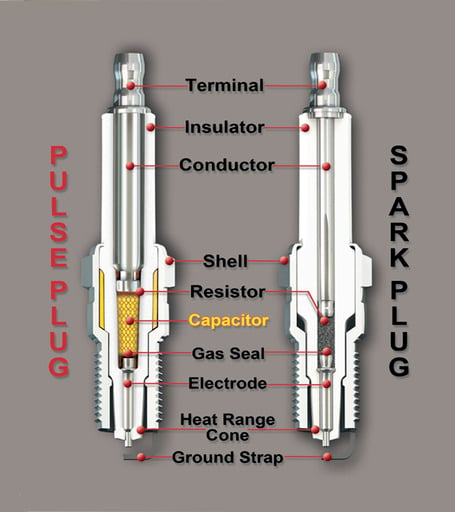
The Pulse Plug looks like a standard plug on the outside, but on the inside is a capacitor that stores energy each firing cycle and releases it in a high-energy pulse. In essence, Pulstar has completely redesigned how the 100 year old spark plug operates and claims it has made the combustion process far more efficient.

And while the Pulse Plug may look like your ordinary spark plug on the outside, it’s what inside that matters. With the Pulse Plug, electrical energy from your engine’s ignition coil is stored in a capacitor within the plug, which is released in a powerful and quick two-nanosecond high-energy pulse when needed. They claim these plugs incorporate a current peaking capacitor to increase peak spark power from 50 watts in traditional plugs to over 1,000,000 watts of fuel igniting power.


Behind The Technology
Over the years, many attempts have been made to take the spark plug to a new level, but the basic principle has remained the same for more than 100 years. The traditional plug has an insulator and an air gap, and a spark is created. But as Camilli explains, auto makers have for years worked around the design limits of the spark plug, with cam phasing, direct injection, stratified charge, and other modifications to get the fuel into the spark.
This cutaway diagram displays the differences between the Pulse Plug and a traditional spark plug. Where an air gap resides between the resister and gas seal in a spark plug, the Pulse Plug houses a built-in capacitor.